It took me a solid 3 years to figure out what chip tells really mean. I had heard/read countless times before about how most pros find chip tells rather than facial or other body tells the most reliable. They study the manner in which players put their chips out when they're weak vs. when they're strong and by detecting a pattern, they can pick up a tell on their opponents.
Sounds easy in theory, but it took me forever to figure out what this really entails. One day, I was talking about it with a pretty good player and it just hit me. It is very true and incredibly accurate that if you look at the way a player releases his chips, it is a consistent tell about hand strength.
What is usually the case is that if a player puts his/her chips out very shakily, knocks over chips, or declares a bet while still in the middle of putting out chips (in other words, just looks very unsure and unconfident while putting out chips), he/she is bluffing. To give an example of the last statement, I was playing with a guy who had maybe $75 in chips in his hand and cut out two stacks of $20 very slowly before just saying, "I make it $150." He was bluffing and I caught him.
Conversely, when a player cuts his/her chips very smoothly and calmly, it implies a big hand. Also, the most obvious and common tell people talk about, shaky hands, implies a monster.
I wish I could put out video of this stuff, because while it sounds easy to pick up, it is actually pretty difficult to explain but such a vital tool in live play.
This concept also took me a long time because I started as a limit player, and I don't think this type of tell has any bearing in limit since people are only putting out 6 chips max per bet.
Here is a crystal clear example of how this tell is so important in live cash games and provides a huge edge over online play. I was playing in a $2/5 NLHE today, about $800 deep in a very aggressive game, and I had AdKd UTG. I limped in with the intention of reraising and a bunch of players called. A guy who was in the BB, a very weak player who with luck had ran his $500 stack into about $1400, raised to $25. He had been doing this shit consistently and I had been consistently popping him in the mouth to get him to stop. I raise to $75 and he just glares at me. I can tell he's fed up and he asks me why I keep doing that. I tell him, "Because I know you don't have a hand, you just love raising preflop." The table folds around back to him and he says, "You know what, I'm gonna call you, you're not doing this again this time." He makes the call and the flop comes down 5c-6c-7d. He immediately pushed $150 in the pot very very shakily when the door card of the 5c came out. He didn't even see the other two cards.
Now there is no hand here he can really represent since he should be scared of me having a big pocket pair here and he probably would have checked a set to me since I will always continuation bet here. It just seemed like such a bizarre bluff-type bet. The bet was big though, so I was in a real shitty position.
Then this guy starts talking. He says, "No matter what you do, if you raise I am going to call no matter how big it is." Strike one.
He then gets up and starts pretending to shout about the Bulls game on TV. He is just all over the place with energy, totally ignoring the hand. Strike two.
Combined with the crazy ass way he put his chips out, all shaky and stuff but not the same type of shaky hands that come with a big hand, I was just so sure this guy was bluffing, maybe he had pocket 8's or 4's but his hand couldn't stand up to a raise. I very very rarely make plays when I play low limit NLHE since the percentage of times you get called is so high and the players are so bad that you can pick better spots when you're like for sure an 80-20 favorite, but this seemed like such a good spot. I just knew this guy was super-weak and bluffing into me. I popped it to $400, telling him if his set cracked my aces he had me, and he insta-called! Uh oh, sometimes your read is wrong I guess.
We checked the turn and the river, though, and lo and behold, he flips up Kc 10c for no pair, just a draw! Sick! My AK high no pair no draw takes down over a $1000 pot! This was mostly because of chip tells and trusting my reads, things that I just could not do online. The $400 raise and talk of aces also froze him so he couldn't bluff on the turn or river.
I would always have to make this fold and give the guy credit online, but in live play this was a very easy raise.
Showing posts with label strategy. Show all posts
Showing posts with label strategy. Show all posts
Tuesday, December 11, 2007

Monday, December 10, 2007
An interesting hand
I hate posting hand histories, I think they're boring but I'll make an exception. Yesterday, I was playing in the $1/2, and I played this hand that had a lot of forethought into it.
I had j-8 in the big blind and the flop came a dream for me, one of the best possible for my hand, 6-7-9 rainbow, giving me an open-ended straight draw (OESD) to the nuts. My opponent was deep stacked and first to act. He took the lead, betting about 1/2 pot on the flop/turn. The river came a beautiful 10 and with no flushes, I held the stone cold nuts. He bet and I insta-raised AI, grossly overbetting the pot. Pot had maybe like $150 and I pushed $300 more. This is kind of a weird play, but this is where hold'em really becomes an art and why I prefer live to online play sooooooooo much.
I was Hollywooding this whole hand, making it very obvious that i was pretending to think about every call even though it was a clear call for me, basically telling this dude that I was on the open-ender.
How am I doing this?
I was holding the chips necessary for the call in my hand as soon as he made the bets and just staring as hard as I could right at his face, then after I took a few seconds to call, I grabbed a huge stack of chips in my hand before he bet the next street. These are all extremely obvious tells of weakness, which I am aware of and I am praying to god he is aware of too (I've played w/ him before and he is a player that at least understands the basics of the game).
Why am I doing this?
I know this guy will bet the open-ended straight in this fashion and I also know he knows I am capable of making a move. I am hoping he holds an 8 in his hand, giving him the 6-7-8-9 OESD. If that ten comes competing the straight, I want to stack him and make him think we are chopping and I'm just trying to steal at the end, even though I would hold the 7-8-9-10-J to his 6-7-8-9-10. The overbet AI is exactly what this looks like when the 10 falls. Unfortunately, he didn't have the open ended draw I put him on and he folded a set of 9's face up to my rather ridiculous raise, screaming at how I was such a fish for the next 5 minutes. I took it in stride, but eventually had to call the floor when he made bodily threats at me.
Even though I lost money by not making a normal-sized raise here that he would have called with his set of 9's, I definitely make lots of money with this play in the long run.
My thought process for this hand was pretty intricate too. When I saw the j-8 preflop, I was thinking, what is the best flop that can come down for me and what are dangerous flops that I need to use pot control on. I don't want the flop that will give me the nuts, like jjj or something. I want the flop that will make the most money for me by hitting other players too. This is what I thought:
Good Flops:
j-8-x
6-7-9
8-8-x
a-k-10
a-q-10
Note: against bad players (which all $1/2 and about half of $2/5 players are), the bottom two of these will make you soooooo much money in the long run, especially in deep-stack games where you can peel a card off against someone who can't get away from two pair.
Dangerous flops where I could go broke and need to play cautiously:
j-j-x
j-8-9/10/q/k/a
It gets very easy to get away from these types of flops/know when you're good when you get some experience under your belt. You will never be a good live player unless you can fold a big hand.
I included this HH for beginner players just to show you the type of thought analysis that should go into your hands. Hope you find this interesting.
Monday, December 3, 2007
Watching for Mistakes
When I sit down at a no limit table, the amount of mistakes I see is oftentimes staggering. It is 100% true that poker is situational and there are many different ways to play a hand correctly, however on the flip side, there are also many ways that are totally incorrect and have no justifiable explanation. These plays will lose you money pretty much every time you do them (-EV) - Joe Sebok and Barry Greenstein refer to them as "zero plays" because they will work 0% of the time.
Most of the mistakes that people make too are so simple to correct - I want to just shake them by the shoulders sometimes and tell them, "What are you thinking? If you just do it this way, you'll make so much more. Here's why!"
If you are a losing player at these levels, it is not variance - low limit games are definitely beatable, and complaining about getting sucked out on, running bad, etc. is simply not a viable excuse. Right now, I am showing a profit in 74% of my sessions, which is ridiculously high. Most pros show a profit in maybe 60% of sessions tops.
When I sit down, on average, I can spot the winning and losing players within about an hour. I would say at the average 10-handed table, there might be one other winning player, a couple of players that make mistakes but are probably break-even, and maybe 4-5 players that just have no clue.
If you want to be a winning player, there are so many options available to you. The forums (twoplustwo.com, fullcontactpoker.com, pocketfives.com, neverwinpoker.com) are a great way to get advice. Emailing people works too. If you have any questions, especially about how you played a hand, you can email me as well: fulltiltazncutie@gmail.com
Saturday, December 1, 2007
The Importance of Good Record-Keeping/Status Update
It has been said ad-nauseum in the poker world, but record keeping is the first step to being a winning player. I'm going to post results in here occasionally for my friends to keep track of my status, but also I want to show what kind of records you should be taking. Here is a screenshot of my excel records page, which is the bare-minimum of note-taking. I should really take more detailed notes:
Note there are columns for win/loss, time and date, hours, locale, notes, etc.
So, IRS quick look that way!
This Week:
Earnings: $523
Hours: 28.5
Hourly: $18.35/hr
Yearly:
YTD Earnings: $6433
YTD Hours: 244.5
YTD Hourly: $26.31/hr
A bad week - I played extremely poorly one day and ran bad another day.
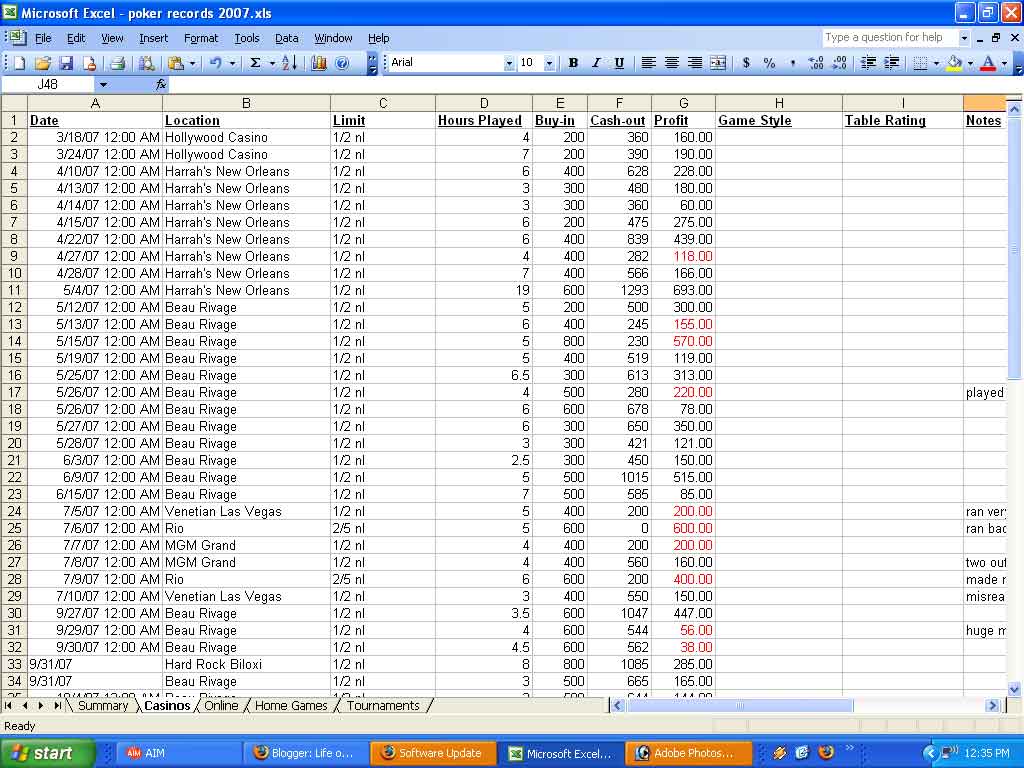
Note there are columns for win/loss, time and date, hours, locale, notes, etc.
So, IRS quick look that way!
This Week:
Earnings: $523
Hours: 28.5
Hourly: $18.35/hr
Yearly:
YTD Earnings: $6433
YTD Hours: 244.5
YTD Hourly: $26.31/hr
A bad week - I played extremely poorly one day and ran bad another day.
Subscribe to:
Posts (Atom)